

To an author, a journal can look like a black box: a manuscript goes in through a submission portal, and weeks or months later a decision comes out. Inside, though, the journey follows a fairly consistent sequence of editorial, ethical and technical stages, each with its own people, systems and reasons for delay.
Workflows differ between publishers, disciplines and peer-review models, and no two journals run them identically. But understanding the broad stages helps authors prepare better submissions and interpret the status messages they receive. It also helps editors and publishers see where their own processes add time without adding value.
This explainer follows a typical research article from submission to its permanent place in the scholarly record. It deliberately avoids quoting average timelines, because published figures vary so widely by field and journal that a single number would mislead more than it informs.
Submission and technical checks
The first step is usually administrative rather than scientific. Editorial office staff, or increasingly automated tools, check that the submission is complete: the manuscript file, figures, author details, declarations of competing interests, funding statements, data availability statements and any ethics approvals the journal requires. Submissions missing essential elements are commonly returned to the author before an editor sees them.
Most journals also run a similarity check at this point. Many use Crossref Similarity Check, a service powered by Turnitin's iThenticate software, which compares the text against published literature and web content. The resulting report highlights overlapping passages, but a similarity score is not a verdict on plagiarism: an editor still has to judge whether the overlap reflects methods text, properly cited material or something more serious.
Integrity screening has broadened in recent years. Depending on the journal, checks may cover image manipulation, authorship changes, undeclared conflicts, irregular reviewer suggestions and signals associated with fabricated submissions. The scale of that problem is examined in our report on paper mills. Where concerns arise, many editors follow guidance from the Committee on Publication Ethics (COPE) on how to investigate and respond.
The desk decision
An editor, often the editor-in-chief or a handling editor with relevant expertise, then decides whether the manuscript should go out for review. A desk rejection usually reflects scope or fit, an insufficient contribution for that journal, or basic methodological problems, rather than a detailed assessment of the science. Fast desk decisions are generally better for authors, because they can resubmit elsewhere without losing months.
Finding reviewers and peer review
If the manuscript proceeds, the handling editor invites reviewers. This is frequently the slowest part of the process: invitations can be declined or ignored, and editors may need to approach many people before securing enough agreements. Our analysis of the peer review bottleneck looks at why this has become harder.
Review models vary. In single-anonymous review, reviewers know the authors' identities but not the reverse; in double-anonymous review, neither side knows; in open review, identities or reports, or both, may be published. Reviewers assess the methods, evidence, interpretation and presentation, and provide a recommendation, but the decision belongs to the editor.
Decisions and revision
Editors usually choose among a small set of outcomes: accept, minor revision, major revision, or reject. Some journals also use "reject and resubmit" for promising work that needs substantial further development, or offer to transfer a rejected manuscript to a sister journal along with its reviews.
Most published papers go through at least one round of revision. Authors return a revised manuscript with a point-by-point response explaining how each comment was addressed or why a suggestion was not adopted. The editor may decide on the revision alone or send it back to the reviewers, which can add further rounds.
Acceptance, licensing and fees
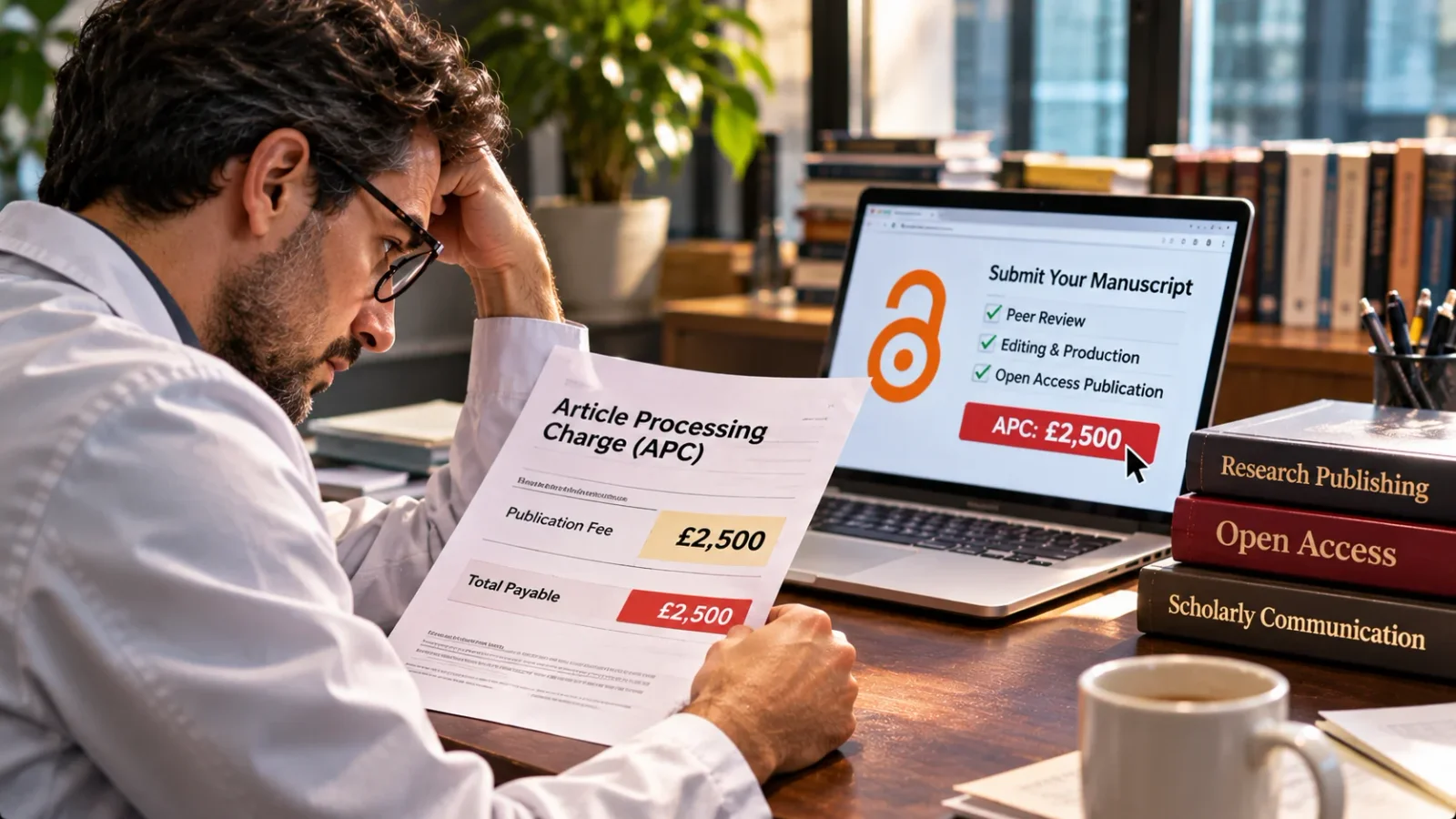
Acceptance ends the scientific evaluation and starts the business and production stages. The author signs a licence to publish or copyright transfer agreement, or, for open access articles, typically confirms a Creative Commons licence. If the journal charges an article processing charge, the invoice, institutional agreement or waiver is settled at this point. JCF Media's explainer on what an APC pays for covers that side in detail.
The accepted manuscript, the version incorporating changes from peer review, has a distinct status of its own. The NISO Journal Article Versions recommended practice distinguishes the author's original, the submitted manuscript under review, the accepted manuscript, the proof and the version of record, along with corrected and enhanced versions. These terms matter because funder and repository policies often specify which version may be shared, and when.
Copyediting, typesetting and XML
In production, a copyeditor corrects language, consistency and house style, checks references and queries ambiguities with the author. The text is then typeset into the journal's layouts for web and PDF.
Behind the visible formats, most journals produce structured XML. The common standard is the Journal Article Tag Suite (JATS), formalised as NISO Z39.96, which defines elements for tagging every part of an article, from author affiliations and funding to references and figures. JATS XML is what allows an article to be rendered consistently, exchanged with platforms and archives, and processed by indexing services.
Proofs
Authors receive proofs to check that copyediting and typesetting have not introduced errors, and to answer outstanding queries. This is not an opportunity to revise the science; substantive changes at proof stage usually require the editor's approval.
DOI registration and the version of record
At publication, the publisher registers a Digital Object Identifier. Crossref members deposit metadata records, including title, authors, dates, funding and the article's online location, under their DOI prefix. The DOI persists even if the article moves platforms, and members are obliged to keep the metadata current. Many publishers also display Crossref's Crossmark button, which tells readers whether an article has since been corrected, updated or retracted.
Many journals publish articles online first, as soon as the version of record is ready, before assigning them to an issue. The online-first article is normally the final, citable version; later issue assignment adds volume, issue and page or article numbers rather than changing the content.
Indexing, archiving and deposit
Publication triggers a set of downstream deliveries. Metadata and content flow to the bibliographic databases that cover the journal, and articles in qualifying biomedical journals, or funded by agencies that require it, may be deposited in PubMed Central, the National Library of Medicine's free full-text archive. PMC deposit is distinct from selection for MEDLINE indexing: one is an archive of full text, the other a selectively indexed citation database.
Journals that take long-term preservation seriously also deposit content with dedicated archives such as CLOCKSS, a library and publisher collaboration that holds content in reserve and makes it openly available if a trigger event, such as a publisher ceasing operation, occurs, and Portico, run by the non-profit ITHAKA. Being archived is not the same as being indexed, and neither is the same as being discoverable through general search engines.
Why timelines vary
The time from submission to publication depends on many variables: how quickly reviewers can be found, how many revision rounds are needed, the length and complexity of the article, the journal's production capacity, the author's own response times, and whether the journal publishes continuously or waits to fill issues. Discipline matters too, with review norms and expectations differing between fields. For that reason, authors should look at the specific journal's published turnaround information, where available, rather than general averages.
Conclusion
A manuscript passes through far more than peer review on its way to publication. Administrative and integrity checks, editorial judgement, revision, licensing, production, identifier registration, indexing and archiving each add something to the reliability and longevity of the published record. Authors who understand those stages can submit more complete manuscripts and respond more effectively at each step. Journals that make each stage visible, from submission status to archiving arrangements, give authors and readers good reason to trust what they publish.