
A journal that charges no submission fee, no article processing charge and no subscription can look almost too good to be sustainable. Yet diamond open access is a legitimate publishing model built around a simple idea: readers and authors should not face a payment barrier.
The important detail is often missing from the promotional description. No author fee is not the same as no publishing cost.
Where the money comes from
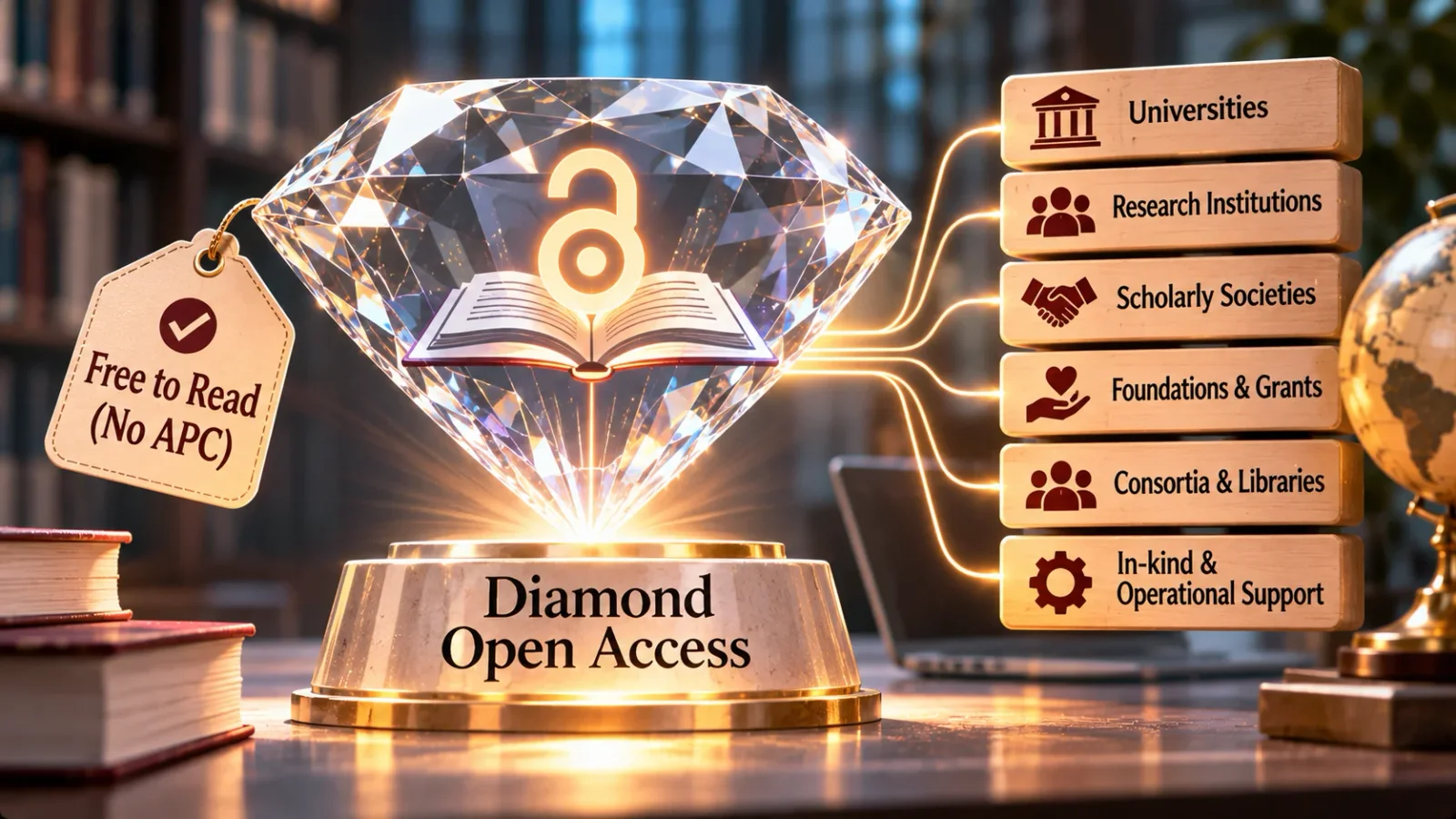
UNESCO describes diamond open access as an equitable model supported through public-interest arrangements, shared infrastructure and open licensing. The funding may come from universities, scholarly societies, research institutions, public programmes or collaborative networks.
A university library might host a journal platform and provide technical support. A scholarly society might cover production expenses through membership income. Academic editors may contribute as part of their professional responsibilities. A public institution might support a collection of local-language journals because they serve a research community that commercial publishers overlook.
These resources are real even when no invoice reaches an author.
The cost structure still matters
A diamond journal needs editorial coordination, a reliable website, manuscript management, accessibility, metadata, identifiers and long-term archiving. Some tasks can be supported by volunteers or shared services, but an entire operation built on one person's unpaid effort is fragile.
If that person retires, leaves the university or loses access to a grant, the journal may struggle to maintain its publication schedule. That is why long-term institutional commitments and documented operating procedures matter as much as goodwill.
Why a no-fee journal can still be rigorous
An APC is a payment mechanism, not a quality indicator. A diamond journal can operate rigorous peer review, provide appropriate research-integrity oversight and maintain professional production, just as a fee-charging journal can.
Conversely, a free-to-publish promise does not guarantee quality. Authors should check the editorial board, policies, discoverability, archiving arrangements and correction procedures regardless of the revenue model.
The transparency principles maintained by COPE, DOAJ, OASPA and WAME require journals to explain their business practices and any author charges—or the absence of them.
The funding question nobody should avoid
Suppose a small journal incurs $24,000 of annual cash costs and publishes 40 articles. That is $600 per article in operating expenditure before accounting for unpaid academic labour. A university could finance the budget directly, or a consortium of institutions could share it.
The illustration does not imply a typical market rate. Actual costs depend on staffing, services and publication volume. It shows why moving away from APCs does not make budgeting optional.
Who is accountable when funding changes?
Diamond journals often sit close to a university department or professional association. That can strengthen their relationship with a field, but also raises continuity questions. Is the journal a formally funded institutional activity, or a project maintained through a temporary grant? Are editorial appointments documented? Who owns the domain, repository and archive if the department reorganises?
A sustainable plan needs more than one enthusiastic academic. It should identify a responsible legal organisation, a budget owner, replacement arrangements for key staff and preservation arrangements for the content already published. These safeguards protect authors who may cite or rely on the work years after the current editorial team has moved on.
Can diamond access expand?
Shared platforms, national infrastructure and community-led governance can help smaller titles sustain themselves. But expansion requires clarity about who owns the journal, who controls editorial decisions, how funds are renewed and what happens if institutional support changes.
The strongest case for diamond access is not that it makes publishing free. It is that it can distribute costs differently while removing barriers for authors and readers. To make that promise durable, the funding and operational arrangements must be as transparent as the access model itself.