

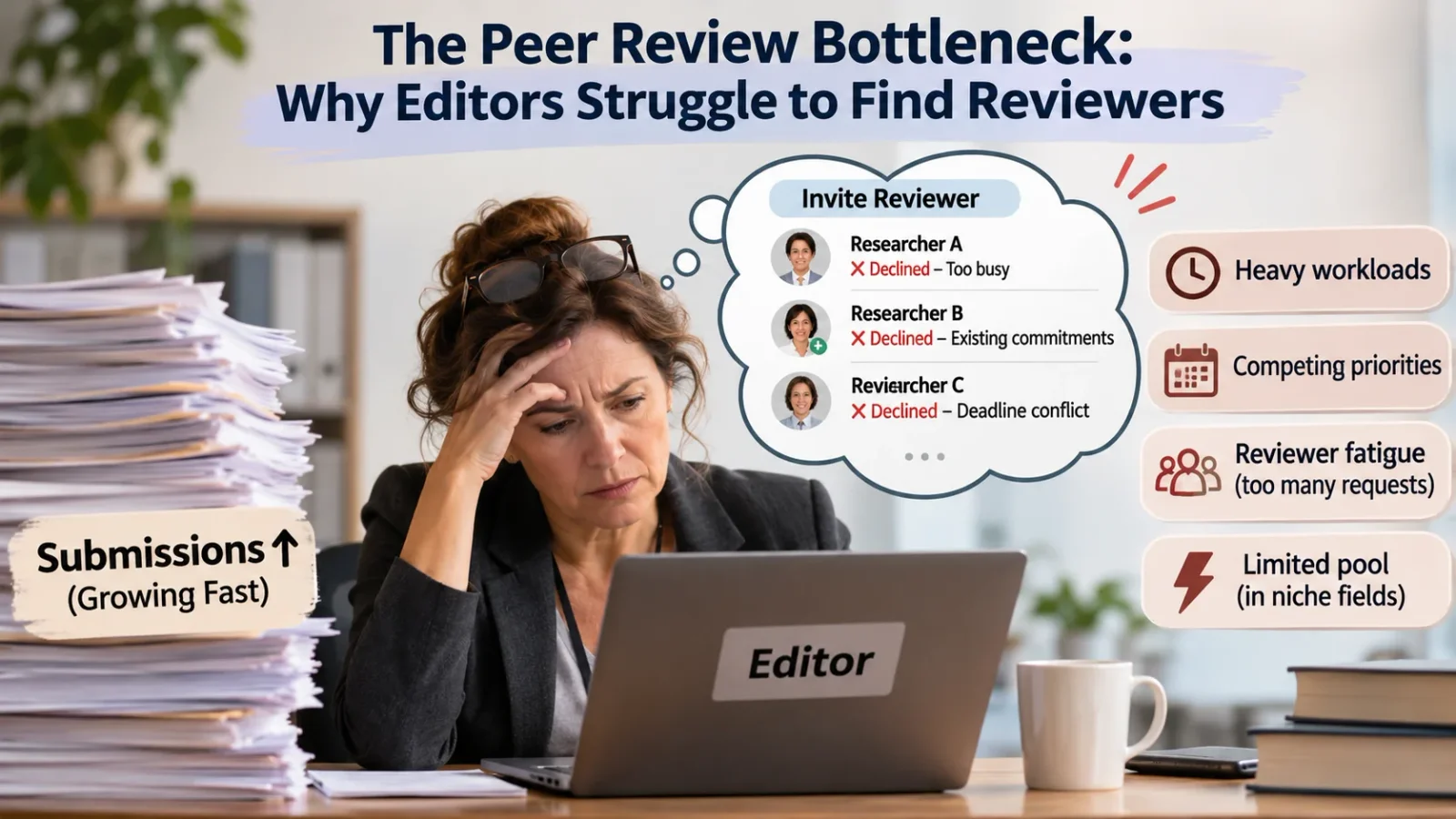
An editor invites six specialists to review a manuscript. Two decline, three do not respond and one agrees but asks for another month. Meanwhile the author checks the submission portal every week.
The delay does not necessarily mean the journal is poorly managed. It reflects an enduring problem in peer review: the people qualified to assess a paper often have the least spare time to do it.
Why recruiting reviewers takes work
Peer review competes with teaching, clinical duties, grant applications and researchers' own manuscripts. The work is usually not compensated like a formal consulting assignment. A reviewer may receive recognition or professional satisfaction, but those benefits do not remove the time commitment.
Highly specialised subjects make recruitment more difficult. An editor must find someone who understands the methods, is available, has no disqualifying conflicts and can provide an independent assessment. Repeatedly inviting the same experts can concentrate the burden on a small community.
The hidden cost of poor invitations
A generic invitation sent without a clear abstract, realistic deadline or explanation of why expertise is needed is easy to ignore. Editors can improve response rates by targeting reviewers carefully and making the request specific.
The journal should also be clear about confidentiality, AI-use policies and review expectations. Reviewers asked to produce lengthy reports on every minor formatting issue may be less willing to accept future assignments.
Better triage protects everyone's time
Not every manuscript needs full external review. A handling editor can often identify work outside scope, missing ethical approval or major methodological problems at the initial assessment stage.
A prompt, well-explained editorial rejection may be more respectful than weeks of unanswered reviewer invitations. For papers that proceed, a focused review request should explain the scientific questions the editor needs help resolving.
Can AI lighten the load?
Approved systems can help editors check manuscript completeness, identify reporting inconsistencies and organise reviewer comments. They may reduce repetitive tasks, but they cannot decide whether a reviewer has the necessary context or whether a manuscript's central claim is credible.
Confidentiality matters. ICMJE guidance cautions that manuscripts should not be uploaded into AI tools where confidentiality cannot be assured without the authors' explicit permission. Journals need clear policies, not improvised use by individual reviewers.
A more respectful reviewer request
A strong invitation tells the potential reviewer why the manuscript fits their expertise, what the main scientific issue is, when the report is needed and whether a short extension is possible. It provides enough information to make an informed decision without exposing unnecessary confidential material.
Reviewers should be able to decline quickly and, where appropriate, suggest an alternative qualified expert. Editorial offices can track invitations and avoid repeatedly contacting someone who has already signalled that they are unavailable. Simple professional courtesy can remove delays that no advanced algorithm will solve.
Recognition and incentives
Some journals offer formal acknowledgment of reviewers, certificates or records of service. Others use editorial-board roles, training or professional-development opportunities. These may improve participation, but recognition should not reward speed or favourable recommendations at the expense of judgment.
Editors should monitor the quality of reports and avoid repeatedly assigning work to people who are no longer available. A reliable reviewer database needs current expertise, conflicts and availability—not simply a growing list of names.
The practical solution
A shorter and more reliable process starts with stronger editorial triage, narrower review questions, verified reviewer identities and respectful communication. Transparent expectations can help authors understand delays without offering guarantees a journal cannot meet.
Peer review is a limited professional resource. Treating reviewers' attention carefully may be more effective than sending more invitations or demanding ever-faster decisions.