

A journal website can be launched quickly and relatively cheaply. That does not mean a trustworthy peer-reviewed journal can be operated at the cost of a website subscription.
The difficult expenses emerge after the first submissions arrive: who screens them, finds reviewers, supports editors, produces accepted papers, maintains the record and investigates complaints years later?
Separate fixed and per-article costs
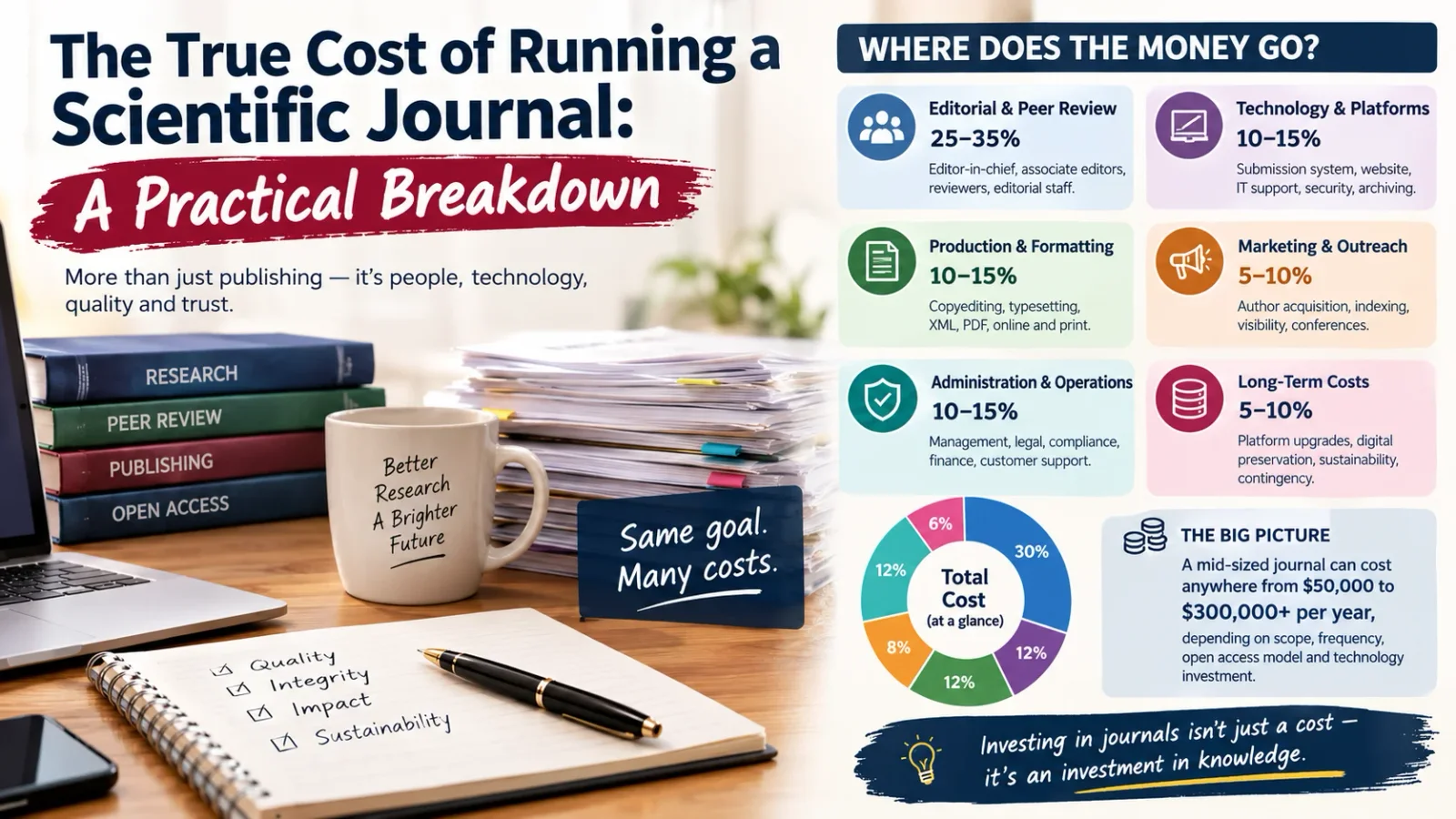
Fixed or semi-fixed costs may include platform access, hosting, security, editorial administration, preservation arrangements, accounting and journal governance. Variable costs can include copyediting, layout, XML production and some article-level technical checks.
The dividing line is not perfect. A publisher may pay a flat production retainer or hire full-time staff who handle several titles. What matters is understanding the costs under the actual operating model rather than relying on a generic price per article.
A realistic workflow for a small title
Imagine a journal receiving 180 submissions and publishing 72 articles each year. It needs to acknowledge submissions, check policies and files, conduct editorial triage, recruit reviewers, coordinate revisions, verify accepted files and produce final versions.
If reviewers and academic editors volunteer their expertise, the publisher still needs to budget for coordination and administration. If those people leave, a replacement plan is necessary. Unpaid work is a resource, not evidence that editorial labour has no value.
An illustrative annual budget
For one fictional journal, consider $18,000 for managing-editor and administrative support, $9,000 for production work, $3,000 for platform and hosting, $2,000 for identifiers, preservation and technical services, and $3,000 for legal, accounting and contingency. That totals $35,000 per year.
At 72 published articles, the simple cash-cost average is approximately $486 per article. This is a planning example—not a benchmark, vendor quote or prediction of what every journal should spend. It also excludes the economic value of unpaid academic work and any owner profit.
A journal with specialist technical checks, paid editors, extensive copyediting or complex clinical requirements could cost more. One supported by university infrastructure could show much lower direct cash expenditure without actually using fewer resources.
What happens when submissions increase?
If submissions double, some workloads grow even when accepted-article numbers do not. More papers need screening, editors need to make more triage decisions and reviewer invitations can increase.
That is why a publishing plan based only on accepted article volume can understate costs. A journal rejecting most manuscripts may still operate a substantial editorial workflow.
Before expanding, estimate staff capacity using both new submissions and accepted publications. Track the hours spent on exceptions, ethics investigations and author inquiries instead of counting only routine processing.
Don't forget the scholarly record
Persistent identifiers need accurate metadata and working landing pages. Corrections should remain connected to the original papers. A publisher should know how its archive will remain accessible if it changes software providers or ceases operating.
Crossref's best-practice guidance emphasises useful metadata beyond the minimum needed to register a DOI. Those improvements take work, but they increase the chance that published research will be correctly discovered and linked.
The financial test
A journal charging APCs should model paid publications separately from total publications because waivers and discounts reduce receipts. A subscription journal should examine renewals, payment cycles and obligations to institutions. A diamond journal needs reliable institutional or community funding even without author invoices.
Whatever the model, keep editorial authority separate from revenue targets. A journal that must accept additional weak papers to pay its bills has a business problem that cannot be solved safely by lowering scientific standards.
The strongest budget is not the lowest possible number. It is one that funds the work a journal has promised to perform—and leaves enough resilience to honour those promises when a difficult manuscript or research-integrity case arrives.