
The manuscript arrives looking ordinary. It has a title, abstract, tables, references and the names of several authors. The subject fits the journal. Nothing in the first page necessarily announces that the research may have been manufactured or that an authorship position might have been sold.
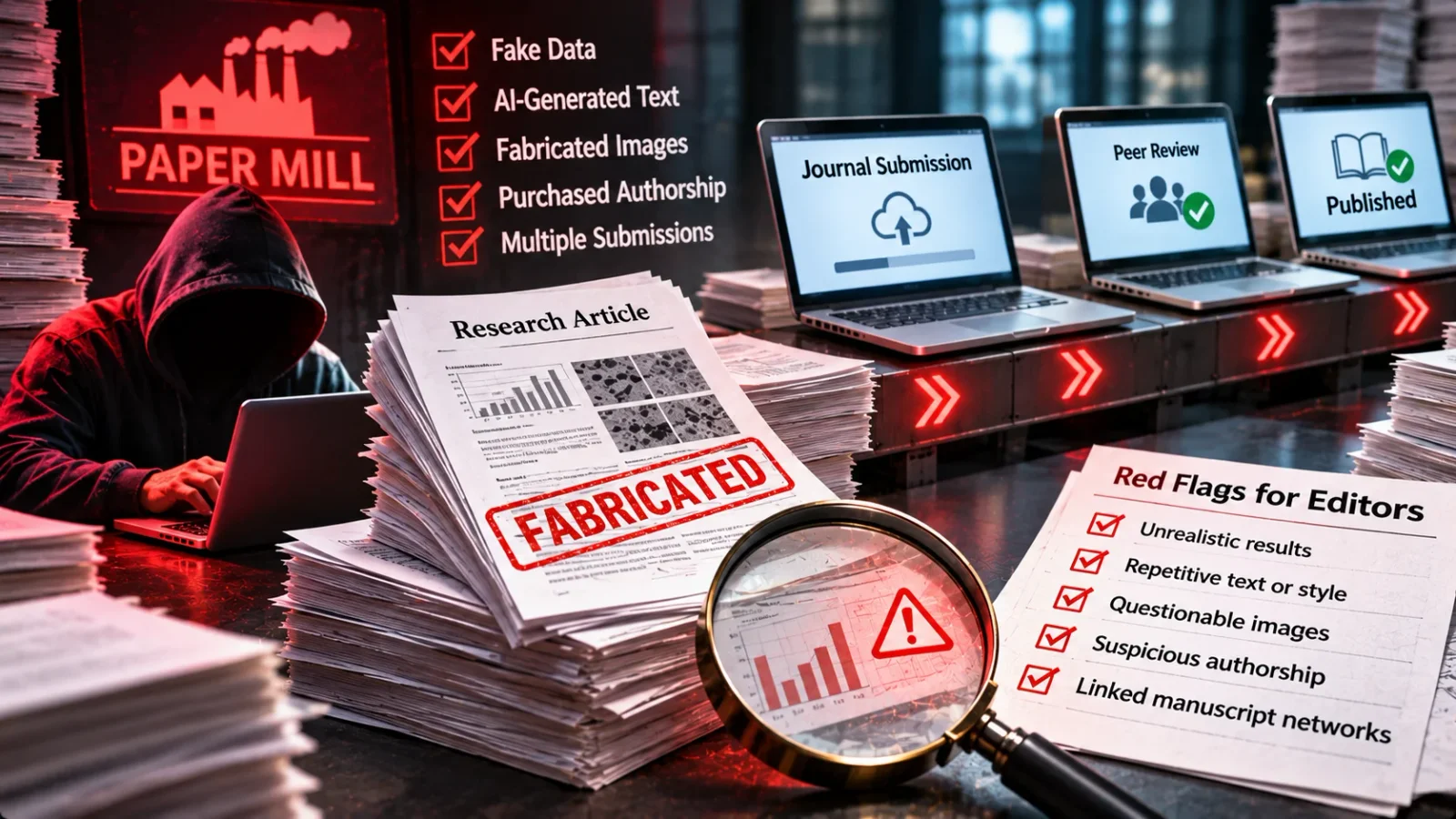
That is part of the difficulty facing editors who encounter paper mills: businesses or networks that produce or arrange scholarly manuscripts for clients who want a publication rather than a genuine research process.
The problem is not the use of professional language editing or legitimate research assistance. It is the misrepresentation of authorship, data, methods or the origin of research.
What makes a paper mill different?
A legitimate editing service helps researchers improve how their own work is presented. A paper mill may instead generate a manuscript with invented or recycled research, offer authorship positions for payment or coordinate submission and peer-review manipulation.
The Committee on Publication Ethics and the International Association of Scientific, Technical, and Medical Publishers have examined paper mills and the difficulty of detecting their activity. Wiley's summary of that research explains that cases can involve manufactured manuscripts submitted on behalf of clients or authorship offered for sale.
Not every suspicious paper is produced by an organised mill. Research misconduct can occur without a commercial intermediary. Equally, unusual language or a non-native English writing style does not establish misconduct. Editors need evidence, not assumptions about how a legitimate author should sound.
Why detection is difficult
Traditional manuscript screening often focuses on plagiarism and whether a paper appears to fit the journal. Paper mills can avoid direct text copying while producing data or images that are unreliable. References may be real but irrelevant. Peer-review suggestions may appear professional while concealing conflicts of interest.
Some manuscripts display broad warning signs: figures inconsistent with described methods, repeated numerical patterns, odd changes between a title and the reported results, or citations that do not support the claims made. A set of submissions may reveal similarities that are invisible when each paper is examined separately.
However, every example has possible innocent explanations. Many legitimate biomedical studies use similar methods and terminology. A laboratory may publish several related papers with shared equipment and overlapping authors. Editors must examine whether the combination of signals supports a specific concern.
The reviewer-invitation vulnerability
Peer review is vulnerable when a journal cannot verify who is reviewing a paper. A suggested reviewer may have an impressive name and convincing institutional affiliation but an email address that is not independently connected to the claimed person.
Editors should confirm reviewer identity through reliable professional information, previous publications or institutional contact routes. They should be particularly careful when multiple suggested reviewers use addresses controlled by a third party or respond with unusually similar language.
None of this means authors should never suggest reviewers. Such suggestions can help specialists find expertise in narrow fields. They simply should not replace independent checks by the journal.
Why editorial speed can become a weakness
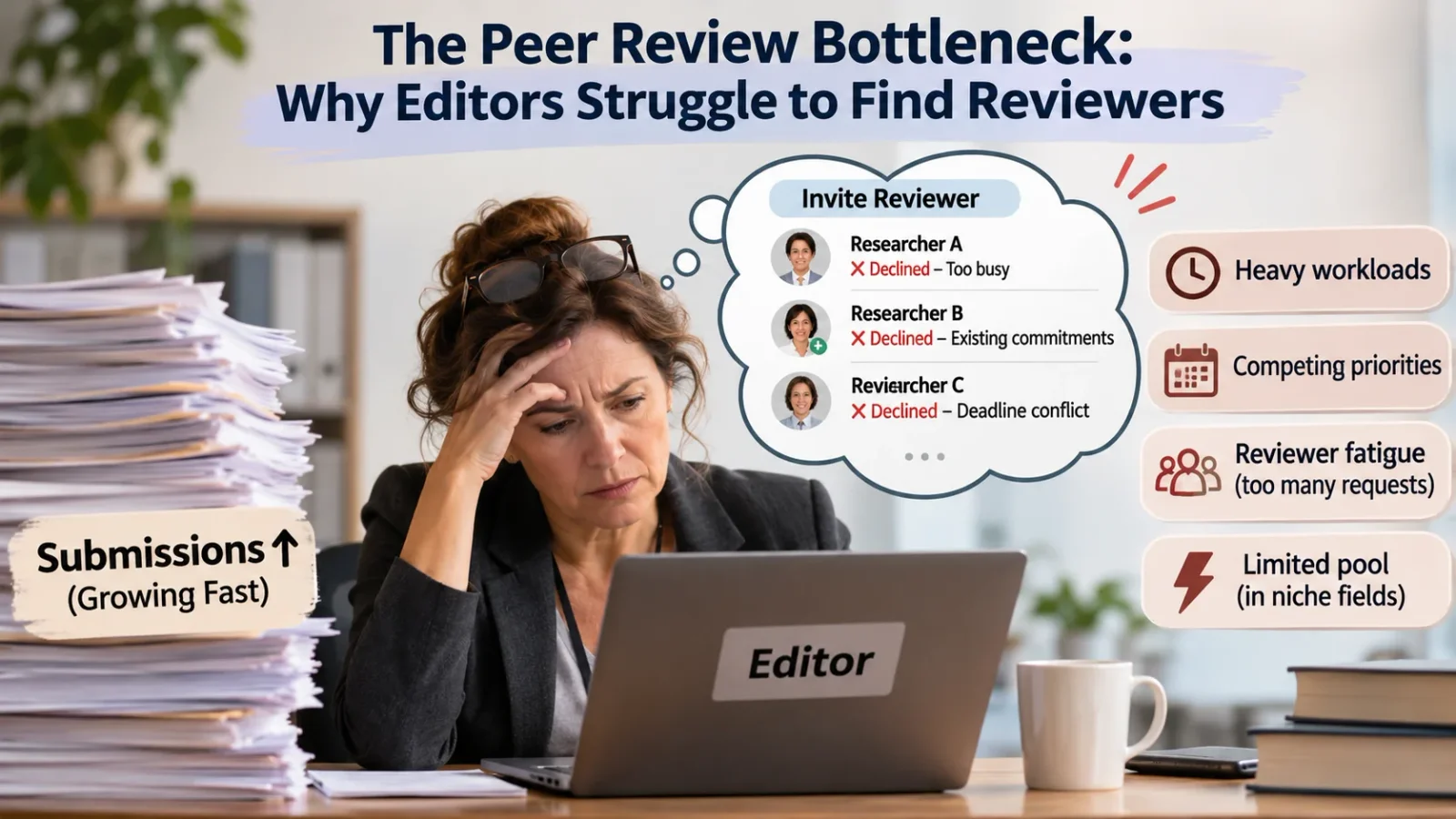
There is pressure from multiple directions. Researchers want fast decisions. Publishers need efficient operations. Managing editors may handle many submissions at once. A service-level target that rewards speed without rewarding verification can invite mistakes.
A journal that promises exceptionally rapid acceptance may also attract applicants who value a predictable outcome over rigorous scrutiny. That does not make a short review period proof of fraud, but it creates a reason to examine whether the workflow contains meaningful independent assessment.
The strongest controls begin before review: scope screening, ethics declarations, metadata checks, figure assessment where appropriate and verification of author and reviewer identities. They continue after publication through corrections, investigations and clear procedures for notifying readers.
What AI changes
AI can make manufactured prose more fluent and can help bad actors generate plausible-looking manuscripts at scale. The same class of technology can assist legitimate editors by checking references, examining internal consistency and comparing submissions for suspicious patterns.
The danger is overconfidence. A tool's 'AI-generated' score is not proof that the research is fraudulent. A human-written paper can contain fabricated data, and a carefully edited paper written with disclosed AI assistance may report legitimate research.
Editors should use software outputs as leads for verification. Where there is a serious allegation, an appropriate specialist needs to evaluate the underlying figures, methods, files and author explanations. Confidentiality, documentation and fairness matter throughout.
The consequences do not stop at acceptance
If concerns emerge after publication, a publisher must determine whether a correction, expression of concern or retraction is appropriate. Those are different responses. A correction can repair an identifiable error without invalidating the work; an expression of concern can alert readers while an investigation is incomplete; a retraction communicates that findings cannot be relied upon under the applicable circumstances.
The record should remain traceable. Crossref's Crossmark service is one mechanism that helps readers find updates, including corrections and retractions, associated with scholarly content.
Removing a PDF without a clear notice can confuse readers and leave unreliable claims circulating through downloads and citations. Responsible record maintenance is part of the integrity response.
What publishers can do this month
Begin with an audit of reviewer identity checks, editorial access permissions, decision records and unusual submission clusters. Train staff to escalate concerns without making allegations prematurely. Make sure editors can pause questionable manuscripts without being penalised for slowing the workflow.
Require transparent conflict-of-interest and authorship declarations. Preserve correspondence and submission history where lawful and appropriate. Investigate repeated concerns across collections or special issues, rather than treating each complaint as entirely isolated.
Finally, do not transfer responsibility for misconduct screening to a single vendor. Publishers remain accountable for the decisions their journals make, even when software or external providers assist with screening.
A challenge for the whole industry
Paper mills exploit incentives as well as technical weaknesses. Where jobs, promotions or degrees depend heavily on publication counts, a market can emerge for people selling the appearance of scholarship. Better screening can reduce opportunities, but it cannot solve every incentive problem.
Universities, funders, editors and publishers each have a role. Institutions can evaluate the substance of research rather than relying only on journal labels or numerical targets. Publishers can maintain independent editorial processes. Authors can refuse services that offer guaranteed acceptance, purchased authorship or invented results.
The useful aim is not to make editors suspicious of every manuscript. It is to make the evidence behind a paper more difficult to fake and the consequences of a compromised record easier for readers to discover.