
The PDF has survived multiple waves of technological change. It is portable, familiar, easy to archive and still central to how researchers read and cite scientific work. Predictions that it will disappear are common; convincing reasons are less so.
Yet the article's surroundings are changing. Manuscripts move through digital review systems, data can be deposited separately, identifiers connect research objects, and AI tools increasingly help people search and interpret the record.
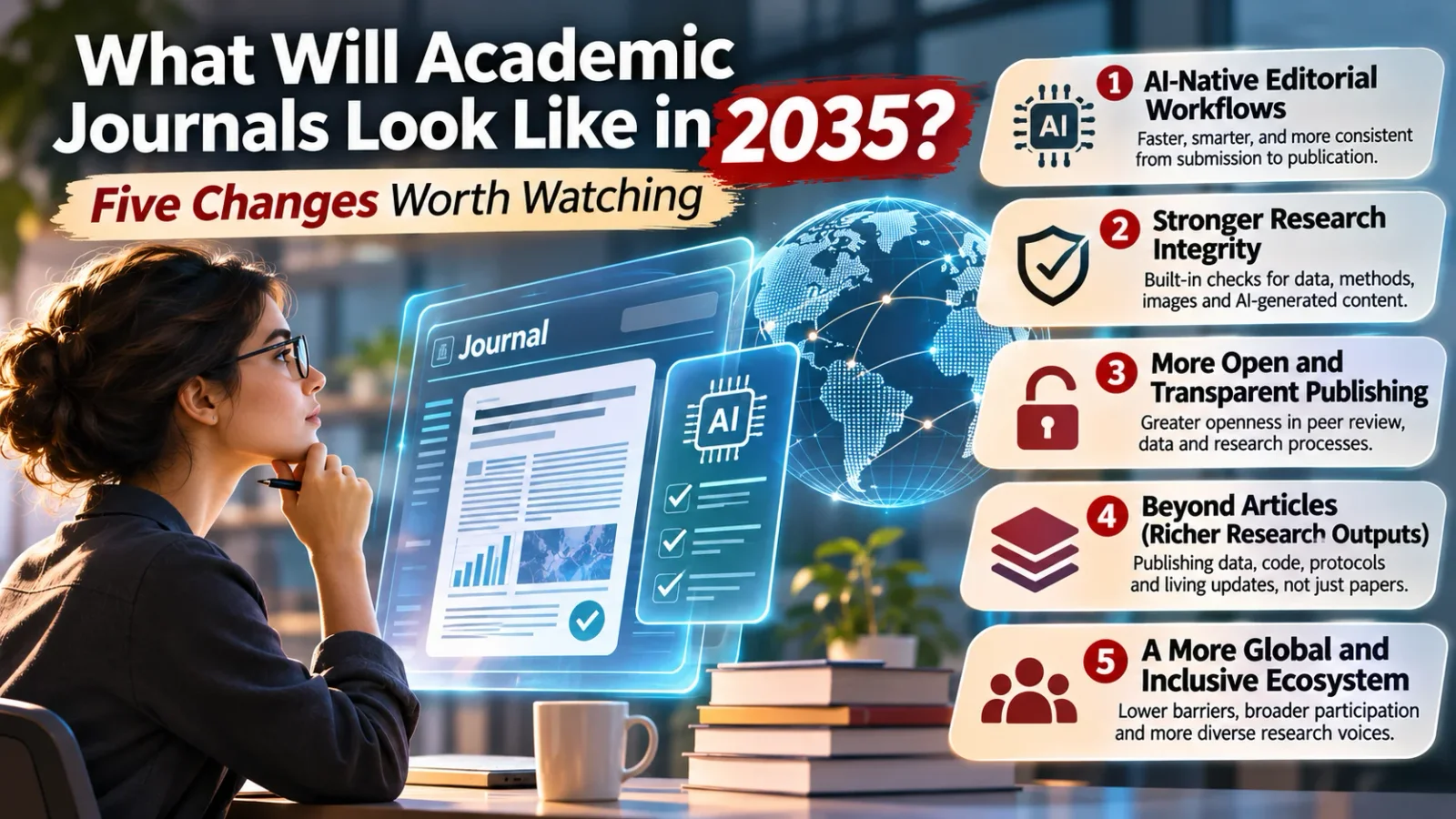
What might an academic journal actually look like in 2035? Five developments deserve attention, provided we treat them as possibilities rather than inevitable outcomes.
1. The article becomes a connected research object
Today's journal page often presents a title, abstract and PDF as the primary product. By 2035, a well-maintained publication could make the relationships around that paper just as visible: underlying datasets, code, protocols, preregistration, funding, contributor roles, peer-review history and subsequent corrections.
The technical foundations are not imaginary. Crossref already recommends richer metadata and supports relationships between scholarly outputs. The challenge is not inventing another identifier; it is ensuring that publishers deposit complete, accurate information and maintain links when material moves or changes.
A reader examining a disputed figure could move directly to the dataset, the method and the correction history where disclosure and rights permit. An editor might see whether the study shares a dataset with another publication. A funder could discover outputs connected to a grant without relying on imperfect text searches.
The risk is creating an impressive network of broken links. Connected scholarship requires stewardship, persistent access and clear responsibility for updates—not simply attractive diagrams.
2. AI becomes routine infrastructure, not a substitute for evidence
By 2035, it is plausible that many editorial offices will use AI-assisted tools for completeness checks, reference validation, manuscript routing, accessibility tasks and detecting inconsistent claims. Some journals may use systems to help reviewers examine methods or statistics.
Whether the tools improve science will depend on what they are evaluated against. A fluent automatic review is not necessarily a reliable one. Systems can misread study design, overstate concerns or reproduce biases from previous literature.
Current guidance from the International Committee of Medical Journal Editors stresses confidentiality, disclosure and human accountability when AI is used in publishing. Those principles are likely to remain useful even as model capabilities improve.
A stronger workflow would treat automated output as evidence to examine rather than an authority to obey. Editors could save time on repetitive checks while keeping responsibility for scientific judgment, conflicts of interest and disputed decisions.
3. Peer review becomes more visible and flexible
Traditional anonymous review has enduring advantages, including allowing candid criticism without exposing a junior reviewer to an influential author. But readers increasingly want to know what was checked before publication and what changed afterwards.
Different journals may respond differently: some could publish review histories with appropriate consent; others may adopt more explicit reporting checklists, specialist statistical review or post-publication commentary. Clinical journals and theoretical mathematics titles will not necessarily benefit from identical processes.
The most useful change would be clarity about what peer review actually certifies. It can improve a manuscript and test its claims; it cannot guarantee that every experiment was performed as reported or every conclusion will survive future evidence.
By 2035, publishers that communicate that distinction well may be more trusted than those advertising review as a universal seal of correctness.
4. Publication models become more diverse
Subscription access, author-paid open access, institutionally supported diamond journals and mixed arrangements are likely to coexist. Different research communities have different resources. A global medical journal with extensive production needs is not financed like a small regional humanities review.
UNESCO's description of diamond open access emphasises that the absence of author or reader fees depends on shared infrastructure and public-interest support. That model may expand where universities, societies and governments commit stable funding.
Other journals may rely on institutional publishing agreements, society subscriptions or transparent author charges. The unresolved question is how to make publication equitable for researchers who have limited funding while preserving strong editorial operations.
An argument that every journal should use one model ignores genuine differences in scale and funding. The better benchmark is whether costs, rights and editorial decisions are clear to authors and readers.
5. The value of a journal shifts from a badge to a service
Indexing and journal-level metrics will continue to influence researcher decisions, but pressure to evaluate individual work on its merits may change how institutions use those signals. The San Francisco Declaration on Research Assessment urges organisations not to use journal impact factors as proxies for the quality of individual papers.
A journal that provides clear methodology checks, strong archival links, rapid corrections, credible peer review and a well-served specialist community has a more durable proposition than one that markets only a ranking.
This does not mean prestigious journal brands will become irrelevant. Reputation is a way readers manage attention. The opportunity is to make that reputation correspond more closely to observable editorial work and the continuing usefulness of published research.
What probably will not change
Scientific claims will still require evidence. Editors will still face difficult decisions where reasonable experts disagree. Journals will still need to explain corrections and guard against conflicts of interest. Researchers will still want recognition and discoverability, and libraries will still care about durable access.
The tools might become faster and the article format richer, but no software can remove the uncertainty that accompanies genuine discovery. New research sometimes overturns old conclusions. A responsible publishing system makes such changes visible rather than treating them as proof that science has failed.
What publishers should do before 2035
The next decade is a long horizon, but useful preparation can begin with modest projects. Improve DOI metadata. Publish clear editorial and AI policies. Test manuscript-screening tools against real errors and false positives. Review whether archived articles and updates remain discoverable. Check if authors can identify the publication license and share underlying research materials responsibly.
Publishers should also examine the economics of their technology choices. A highly customised platform may become expensive to maintain. A fully outsourced workflow may create dependence on one vendor. Neither option is inherently wrong, but continuity plans and data portability deserve attention.
An independent journal can make progress without trying to imitate every feature offered by a large multinational group. Reliable editorial handling, honest communication and well-maintained metadata are competitive strengths even on a modest budget.
The journal of 2035 may still display a PDF download button. What will distinguish a good one is the quality of the evidence, relationships and editorial decisions that readers can discover around it.