
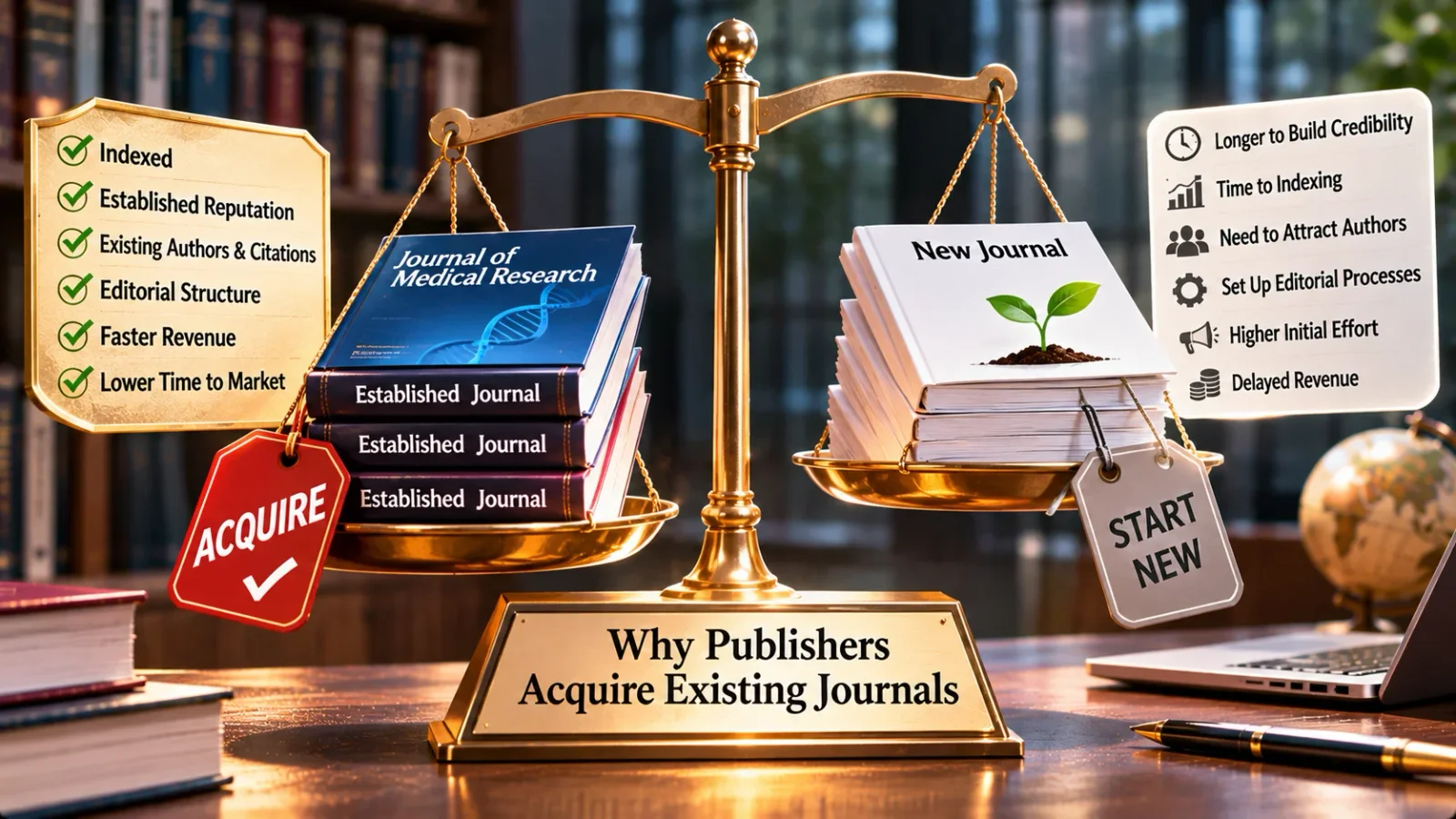
Launching a new academic journal requires years of work: assembling editors, finding reviewers, establishing trust, building a publishing record and persuading authors to submit. Buying an existing title can appear to offer a shortcut.
That helps explain the appeal of journal acquisitions. Yet an established name is useful only when the rights, editorial relationships and ongoing obligations actually transfer.
What a buyer hopes to gain
An existing journal may offer a recognised title, historical citations, a stable readership, manuscript traffic, an archive and established operational arrangements. Some titles also have subscription or article-processing-charge revenue.
For a publisher building a subject portfolio, acquisition can be faster than developing a new brand. It may also reduce duplicated platform costs by bringing production and editorial administration into an existing operation.
These benefits are possibilities, not guarantees. The reasons a title is attractive may be exactly the aspects a buyer has least control over.
The ownership question comes first
Some journals are owned by scholarly societies and published under renewable service contracts. Others are owned by commercial publishers or universities. A publishing agreement is not always an asset that can be assigned to a buyer.
A due-diligence review should identify title and trademark rights, domains, archives, DOI records, current contracts and responsibility for manuscripts already under review. If editorial or society consent is required, that needs to be addressed before completion.
Indexing is a risk, not transferable property
A seller may emphasise that a journal is indexed in Scopus or another database. Buyers should verify the actual title record, ISSNs, coverage dates and any concerns or changes in status.
Elsevier's Scopus policy explicitly discusses journal ownership, title and editorial changes. Continued coverage is not automatically guaranteed after such changes. A buyer can acquire journal assets; it cannot purchase a permanent promise from an independent indexer.
Editorial continuity can decide the outcome
A respected editor-in-chief may be the main reason scholars trust a specialist journal. If that editor resigns after the transaction, manuscript submissions may fall and reviewer relationships may weaken.
Buyers should understand how editors are appointed, whether the existing board plans to stay, and how editorial independence will be protected. A transition plan should also cover pending submissions, appeals, reviewer confidentiality and author payments.
The financial records need to reconcile
Gross APC invoices do not prove collections. Subscriptions may renew unpredictably. Some operating work may have been supplied by the seller without a salary. A credible analysis checks bank receipts, processor fees, refunds, deferred income, contracts and the cost of replacing those services.
A journal with growing publication numbers but weak cash conversion may be less attractive than one with modest output and reliable finances. Historical profits should be adjusted for staff, platform, compliance and archiving costs under the buyer's ownership.
What a sensible transition timetable looks like
Before closing, the parties should establish who has access to submitted manuscripts and which permissions allow data to be transferred. At completion, they should document the legal rights, transfer or retain domain control as agreed, notify relevant service providers and arrange uninterrupted communication with editors and authors.
After completion, DOI metadata, journal contact details and public ownership statements may need updating. The buyer should avoid simultaneously changing the platform, the editor-in-chief and every author-facing policy unless there is a compelling reason. A phased transition reduces confusion and makes it easier to identify the cause if something goes wrong.
Why a good acquisition can still fail
Problems arise when a buyer migrates technology too quickly, replaces editorial processes without consultation or treats an indexing badge as a substitute for a quality-control programme. An acquisition should preserve the journal's scientific continuity while making operations more reliable.
The soundest reason to acquire a journal is that the buyer can sustain and improve its service to a research community at a defensible price. Buying a name without understanding what makes authors trust it is a far riskier strategy.