
A journal can spend years attracting international authors, improving its editorial procedures and building a publication record before gaining a place in Scopus. For many publishers, inclusion becomes a major part of the journal's identity. Then an indexing decision changes, and the question authors ask is immediate: will my paper still count?
The answer depends on something that is often overlooked in online discussions. A journal's future coverage can stop without every article already indexed being erased. Not every change in coverage is a finding of misconduct, either.
How a journal comes under review
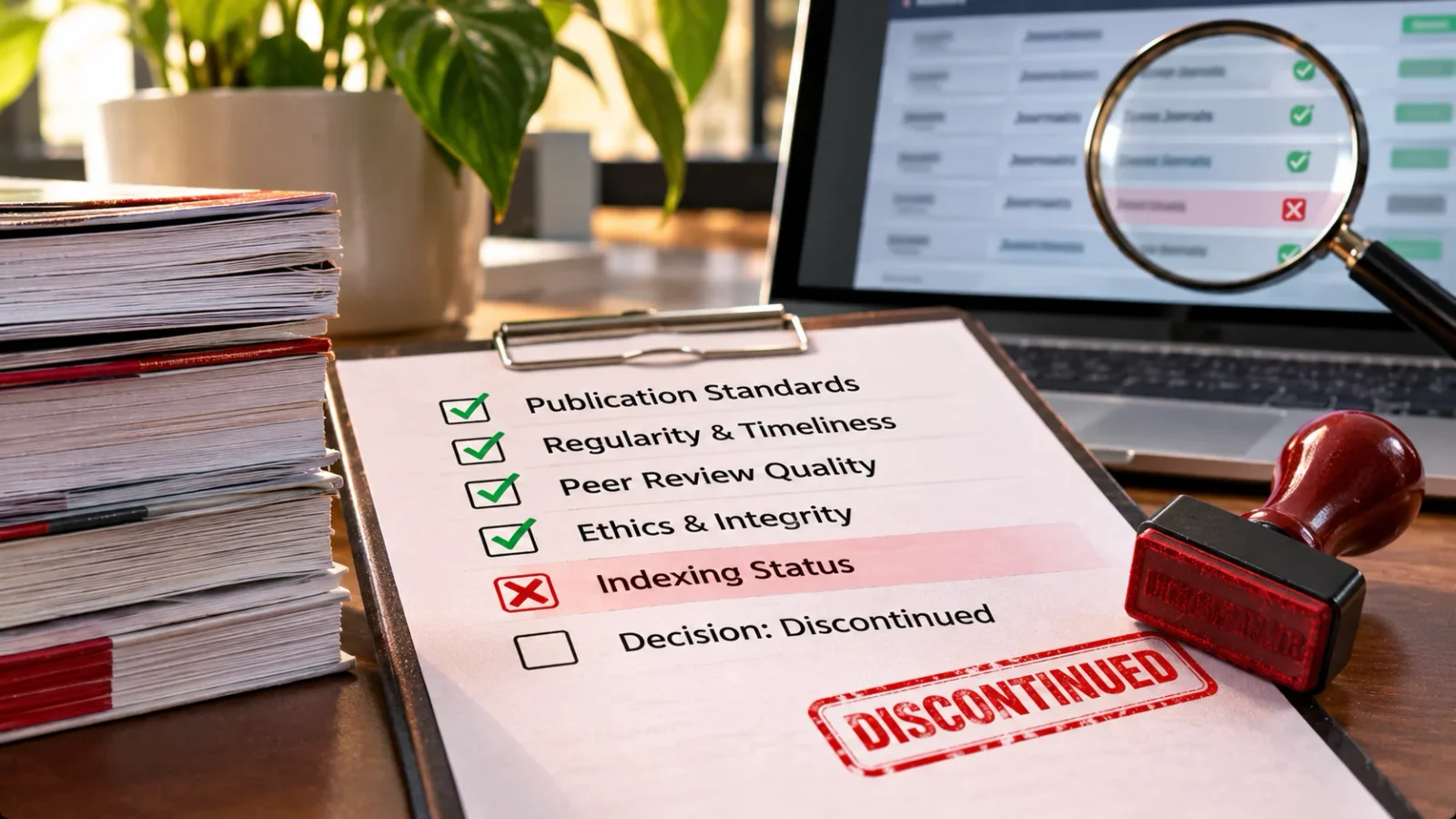
Scopus, operated by Elsevier, uses a Content Selection and Advisory Board to evaluate journals against criteria involving editorial policy, academic contribution, journal standing, publication regularity and online availability. Passing the initial review does not guarantee coverage forever.
Elsevier describes an ongoing re-evaluation programme. Concerns from the research community may be examined, while data analysis can flag unexpected patterns in publication activity, citation relationships, author collaborations or content. A journal may be asked to provide further information during review.
The existence of an anomaly is not a verdict. A journal that rapidly expands from 80 to 300 articles a year may have built a stronger editorial operation. Another title may have increased output without enough qualified editors or reviewers. The relevant question is whether standards were maintained, not whether the publication crossed a universal article-volume threshold.
What happens while a decision is pending?
Scopus says that content flow for a title undergoing re-evaluation is suspended while the assessment takes place. The board then decides whether coverage should continue or future coverage should be discontinued. If a title continues, content flow resumes.
For publishers, this means the phrase 'under review' should never be casually substituted for 'discontinued'. Those are different stages with different consequences. Authors should ask the journal for the precise status and check the official source records.
There is also a terminology trap. Scopus support material distinguishes titles that are inactive, titles discontinued following quality assessment, and titles whose former names stop receiving coverage after a title and ISSN change. A headline describing all three as 'banned journals' would mislead readers.
Do previously published papers disappear?
Generally, no. Elsevier says content already indexed remains in the database after discontinuation or a hold, preserving the scientific record and consistency of research analytics. It also notes exceptional circumstances in which historical content may be removed following proven, severe unethical publishing practices.
That still leaves an important uncertainty for an individual author. A paper published on the journal website is not necessarily indexed in Scopus. A valid DOI does not automatically create a Scopus record. A journal's indexing status at manuscript submission is also not identical to the status of a particular paper in a particular coverage year.
Researchers should therefore verify the journal's official coverage period and look for their own article in Scopus. If an institution requires indexed publication for promotion or a degree, its written rules about the relevant date should be checked separately.
Does discontinuation mean the journal was predatory?
No such conclusion follows automatically. A journal may have ceased publication, undergone a title change or failed a quality re-evaluation. Different circumstances deserve different descriptions.
When quality concerns are involved, they should be reported accurately and taken seriously. But a discontinued status alone does not establish that every paper in the journal is unreliable, nor does it establish wrongdoing by every author or editor.
The reverse is equally important. Being included in an indexing service does not certify that every published article is sound. Readers still need to evaluate the evidence and methods of the individual study.
Why publishers feel the decision financially
Indexing can influence where researchers submit. If submissions decline after future coverage is discontinued, a journal operating on article processing charges may experience lower revenue even while its editorial, hosting and archiving obligations continue.
Consider a purely illustrative journal that publishes 200 paid articles at an average fee of $800. Gross publication-fee income would be $160,000 before costs and waivers. If paid output later fell to 100 articles at the same fee, gross income would be $80,000. This is an arithmetic scenario, not a claimed average loss from discontinuation.
The calculation explains why indexing risk matters in journal acquisitions and expansion plans. Buyers should not assume that an indexing service's future decisions are assets a seller can guarantee.
Can a journal regain inclusion?
Scopus publishes policies for reconsideration and resubmission, including an embargo after discontinuation. Publishers should consult the current rules rather than relying on old advice circulating online. Reapplication is not the same as automatic reinstatement.
A journal seeking to improve its position should examine the documented reasons for concern and respond with operational evidence. That might involve stronger editorial independence, clearer peer-review records, better research-integrity checks, transparent policies or sustainable publication schedules.
Changing a website design or adding prominent names to an editorial board is not an adequate substitute for those improvements.
Why an indexing screenshot is not enough
Scopus makes source-title information available through its official records and lists, which are updated periodically. An old promotional banner cannot tell an author whether new articles remain eligible for indexing. The journal title, print and electronic ISSNs and coverage dates must match the exact publication under discussion.
Where a report names a particular journal as discontinued, a responsible publisher or news outlet should retain evidence of the checked source record and the date of verification. This protects readers from confusing a title change with a quality-based discontinuation and gives the journal an opportunity to explain relevant circumstances.
What authors and publishers should do now
Authors considering a journal should verify its current official coverage, publication scope, peer-review standards and fee policies. Authors with previously published papers should retain publication dates, identifiers and institutional correspondence where eligibility may be questioned.
Publishers should monitor editorial quality continuously instead of treating indexing as a permanent marketing badge. The number of manuscripts received, rejection decisions, reviewer participation, corrections and unusual citation patterns can reveal changes worth investigating—but no single dashboard measure proves a journal is good or bad.
Scopus indexing can open doors for a journal. Its long-term credibility depends on something less visible and more difficult to build: a publishing operation that earns the confidence of researchers whether or not a database badge appears on the homepage.